
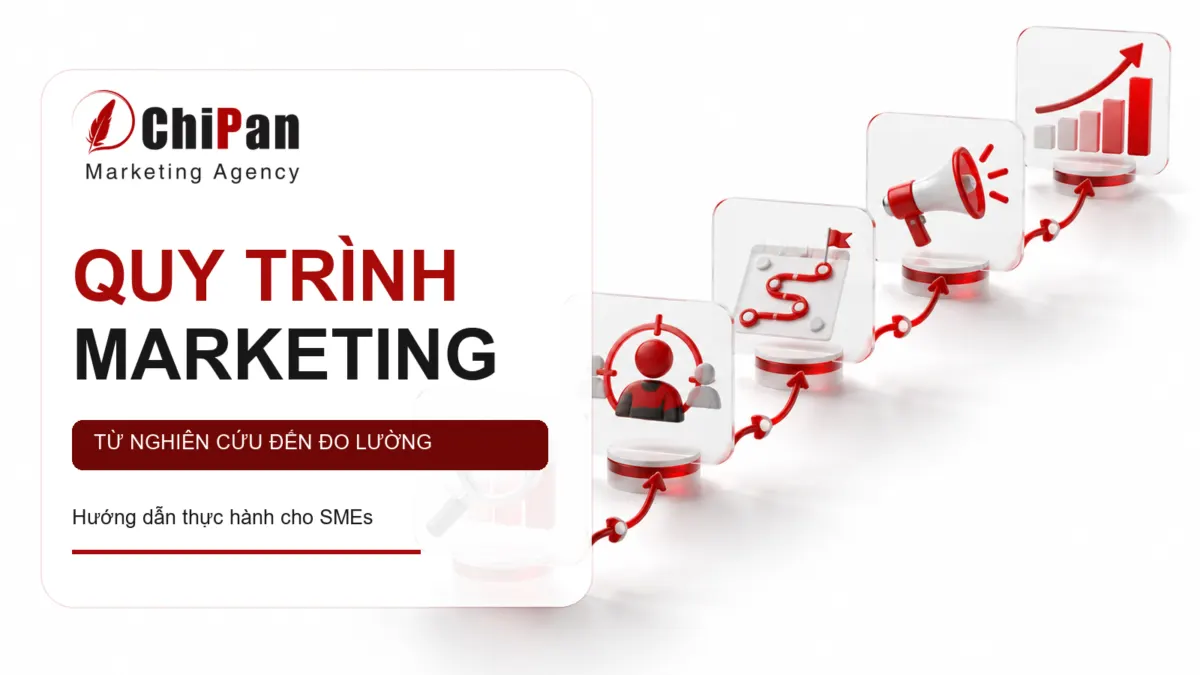
Key takeaways
The 9-step marketing process helps SMEs connect business goals with research, positioning, channels, deployment, KPI, measurement and optimization.
Quick reply: The marketing process is a continuous workflow from identifying business goals, researching the market and customers, choosing segments, building positioning, planning channels, producing content, deploying, measuring to optimal. With SMEs, an effective process requires a responsible person, output criteria and KPIs at each step.
Many businesses deploy marketing by starting right from advertising, content or a platform that is gaining attention. This approach can create activity, but not necessarily create business results. When goals, customers, messages, data and responsibilities are not connected, the team is easily busy without knowing which part is actually generating lead, revenue or returning customers.
This article presents a Marketing process 9 steps for SMEs. Each step has inputs, outputs, and test questions so that business owners or marketing leaders can use when planning, assigning and evaluating performance.
Category
- What is the marketing process?
- 9 steps in the marketing process
- Step-by-step output checklist
- How to choose KPIs and measure
- Common SMS errors
- When to do it yourself, when to hire an agency?
- Frequently Asked Questions
What is the marketing process?
The marketing process is a system of steps that help businesses transform business goals into measures to approach, persuade and retain customers to measure. This process did not end after the campaign aired. Deployment data must go back to the research and planning step to form an improved loop.
A good process should answer four admin questions:
- What business results do you want to change?
- Which customer group is the most important at this stage?
- Marketing needs to make changes in perception or behavior?
- What data indicates the plan is on the right track?
The process is different from the plan. The process describes how businesses do repeat marketing and who is responsible. The plan describes objectives, activities, budgets and schedules for implementation in a specific period. You can refer to more 10-step marketing plan framework for SMEs.
9-step marketing process from research to measurement
Step 1: Convert your business goals into marketing problems.
Marketing should not start with the question of “posting which channel” or “how much to run ads”. Let's start with the business results that need to be impacted: increase new customers, increase return rates, open a market, improve order value or shorten closing time.
Then turn the business goal into a specific marketing problem. For example, if a business wants to increase revenue from a service with a good margin, the marketing problem could be to increase the number of qualified consultations for that service, instead of just increasing the reach.
The output should be: a priority goal, timeline, result index and owner.
Step 2: Research the market, customers and competitors
SMEs do not necessarily do a large-scale study. Businesses can start from existing data: sales calls, inbox questions, search keywords, customer reviews, reasons for losing orders, CRM data, website behavior and post-purchase feedback.
Distinguish three types of information:
- data: What can be observed or verified, such as lead source, closing time, return rate.
- Feedback: What the client says directly in interviews, messages or surveys.
- hypothesis: Assessment needs to be checked by data or testing.
The output should be: List of needs, barriers, selection criteria, purchase journey and competitive gaps.
Step 3: Select the segment and customer priority
Customer portraits are only useful when helping businesses make decisions. Instead of a general description by age and gender, identify the buying scene: who initiates the need, who influences, who approves the budget, what makes them procrastinate and what evidence makes them believe.
For a B2B enterprise or a high-value service, a segment can be determined by industry, size, maturity level, operational issue or timing of demand. Enterprises should prioritize the group that has both clear needs and suitable service capacity.
The output should be: One to three priority segments and exclusion criteria.
Step 4: Build positioning, value propositions and messages
Positioning is not a slogan. The positioning needs to explain who the business serves, how to solve the problem, how and why the customer should believe.
Each important message should have three layers:
- Value promise: Change the desired customer.
- mechanism: The process, product, or method of making that change.
- Proof: Data, competencies, processes, certifications, or verifiable experiences.
The output should be: A core message and variations in stages of the customer journey.
Step 5: Design the journey and choose the role of each channel
Not every channel does the same task. SEO can catch existing search needs. Social helps to create attention, educate the market and build memorization. Advertising helps to speed up distribution. Email, CRM and business team help nurture and convert.
Before choosing a channel, determine the role of the channel in the journey: create awareness, attract demand, receive lead, support evaluation, single-lock or retain. As a result, businesses avoid evaluating a recognition channel only by a direct number.
The output should be: Customer journey map, channel role and transfer point between marketing and sales.
Step 6: Plan your activity, content and budget
The plan needs to connect each activity with goals and resources. For each item, specify the person in charge, completion deadline, expected cost, acceptance criteria and monitoring index.
The budget is not just advertising money. Enterprises need to include the production cost of content, tools, personnel, landing page, data, incentives and time of the sales team. If there is a shortage of resources, it is advisable to reduce the number of channels or campaigns instead of spread out.
The output should be: Activity schedule, content plan, budget, RACI or assignment table.
Step 7: Prepare data infrastructure and operating standards
Enterprises need to agree from the beginning how to name the campaign, the source of the lead, the lead status, the conditions of a qualified lead and the time to hand over to the sales. If each person writes data in a way, the ending report will not be reliable enough to make a decision.
Website, form, CRM, phone number, UTM code and conversion events should be checked before the campaign runs. Google Analytics notes that Attribution is the allocation of contributions to the touchpoints on the journey that leads to important action; Therefore, businesses should not assume that all results are created by the final touch point.
The output should be: Tracking plan, data convention, dashboard and checklist check before running.
Step 8: Deploy, quality control and coordinate with sales
Before release, check content, links, forms, phone number, mobile display, preferential conditions and LEAD processing scenario. In the early stages, marketing and sales should briefly meet with a fixed rhythm to check the quality of lead, common feedback and handover bottlenecks.
Business owners do not need to approve each word, but need to see the goals, risks, budget, progress and decision-making criteria.
The output should be: Campaigns QA, SLA handle leads, reporting calendars and diary changes.
Step 9: Measure, Learn and Optimize
Measurement is not just for making monthly reports. The data should answer three questions: what happened, why it could happen, and what the business will change next.
Let's divide the optimal decision into three levels:
- Daily: Technical errors, unusual budgets, leads are missed.
- Weekly: Content, customer group, message, lead quality and transition rate.
- Monthly or quarterly: Budget allocation, priority channels, positioning, offer and team capacity.
The output should be: Conclusion is based on data, optimal action, executor and re-evaluation.
Marketing process output checklist
| Pace | Minimum output | Test Question |
|---|---|---|
| 1. Goal | Target, Deadline, Owner | Is it associated with business results? |
| 2. Research | Needs, barriers, journeys | Where is the data, what is the hypothesis? |
| 3. Segmentation | Priority and exclusion groups | Does this group have the right needs and serviceability? |
| 4. Positioning | Messages and evidence | Can the difference be proved? |
| 5. Channel | Journey and role of each channel | What does each channel do? |
| 6. Plan | schedule, budget, responsibility | Are there enough resources to do the right quality? |
| 7. Data | Tracking Plans and Conventions | Can you track lead to revenue? |
| 8. Deployment | QA, SLA, Coordination Calendar | Who handles when there's an error or a new lead? |
| 9. Optimal | Conclusion and next action | What decision changes after viewing the data? |
How to choose KPIs for the marketing process
One KPI should not be used for the entire journey. SMEs can build three floors of measurement:
- Business results: Revenue, gross profit, new customers, return rate or lifecycle value.
- Marketing results: Lead Qualify, Appointment, Sales Opportunity, Order and Cost on Results.
- Diagnostic index: Click rate, form fill rate, response rate, step rate and lead processing time.
The diagnostic index helps to find the cause, but should not replace the business results. A campaign with a lot of views can still be inefficient if not created right or lead is not handled in time.
Google Analytics also shows that the conversion journey can include multiple touchpoints and Attribution is used to allocate contributions between those touch points. Businesses should read the data on a journey instead of just looking at the last click. See more official instructions of Google Analytics about Attribution.
5 errors that make the marketing process not work
- Start from the channel instead of the goal: The team chooses TikTok, Facebook or Google before identifying the problem.
- No one is responsible for: Many people participate but no one has the right to make the final decision.
- Marketing and Sales use two different lead definitions: The report has many leads but the sales team thinks the quality is low.
- Measure activity instead of result: Posts, views, and clicks are reported but not linked to sales opportunities.
- Optimized too early or too late: Change after a few days when there is not enough data, or keep it for too long even though the signal is bad.
When should SMEs operate on their own, when should they hire an agency?
Enterprises can operate on their own when someone owns a goal, has core deployment capacity, clear enough data and stable workload. Agency is more suitable when businesses need to quickly supplement strategic capacity, multi-channel management, measurement system or deployment team but do not want to recruit enough positions.
The combination model is often realistic with SMEs: the business keeps product knowledge, customers, data and decision power; The agency supports strategy, plan, expertise by channel, production and reporting system.
When evaluating a partner, compare the scope of work, coordination mechanism, data ownership, acceptance criteria and reporting. Card Criteria for selection of marketing agency in HCMC Provides a more detailed reference frame.
Frequently asked questions about the marketing process
What are the steps of the marketing process?
A practical process for SMEs can consist of 9 steps: targeting, research, segment selection, positioning, cruise and channel design, planning, data preparation, implementation and optimization.
How is the marketing process different from the marketing strategy?
The strategy determines where the business will compete, who serves and how to create different values. The process determines how the team turns strategy into repetitive, responsible and measured work.
Does a small business need 9 steps?
Yes, but the depth may vary. An SME can use customer interviews, sales data and simple spreadsheets instead of large research or expensive systems. It is not recommended to ignore targets, customers, tracking and optimal loops.
How long should the marketing process be reviewed?
Operational bottlenecks should be checked weekly. Channels, budgets and messages can be reviewed monthly. Positioning, segmentation and large targets should be reviewed quarterly or when the market changes significantly.
How do you know the marketing process is problematic?
The common signs are the target of constant change, the report does not connect to revenue, marketing and sales debates lead quality, data between systems does not match or no one is responsible for the transfer step.
Conclude
The marketing process helps SMEs move from discrete operations to a system with goals, responsibilities, data, and improved loops. Businesses don't need to make things complicated in the first place. Standardize the output of each step, select a few key KPIs and keep a steady rate of evaluation.
Chipan Marketing Agency Support businesses to review marketing processes, identify bottlenecks, design implementation plans and organize coordination between marketing and business. If you need an independent perspective before increasing your budget or hiring more staff, contact Chipan to schedule an exchange.
Reference source
- U.S. Small Business Administration: Marketing and Sales — Check on October 13, 2026.
- Google Analytics Help: Get Started With Attribution — Check on October 13, 2026.

ChiPan Marketing AgencyFrom creative work, content and advertising to restructuring marketing, sales channels and the operating model.