
Key takeaways
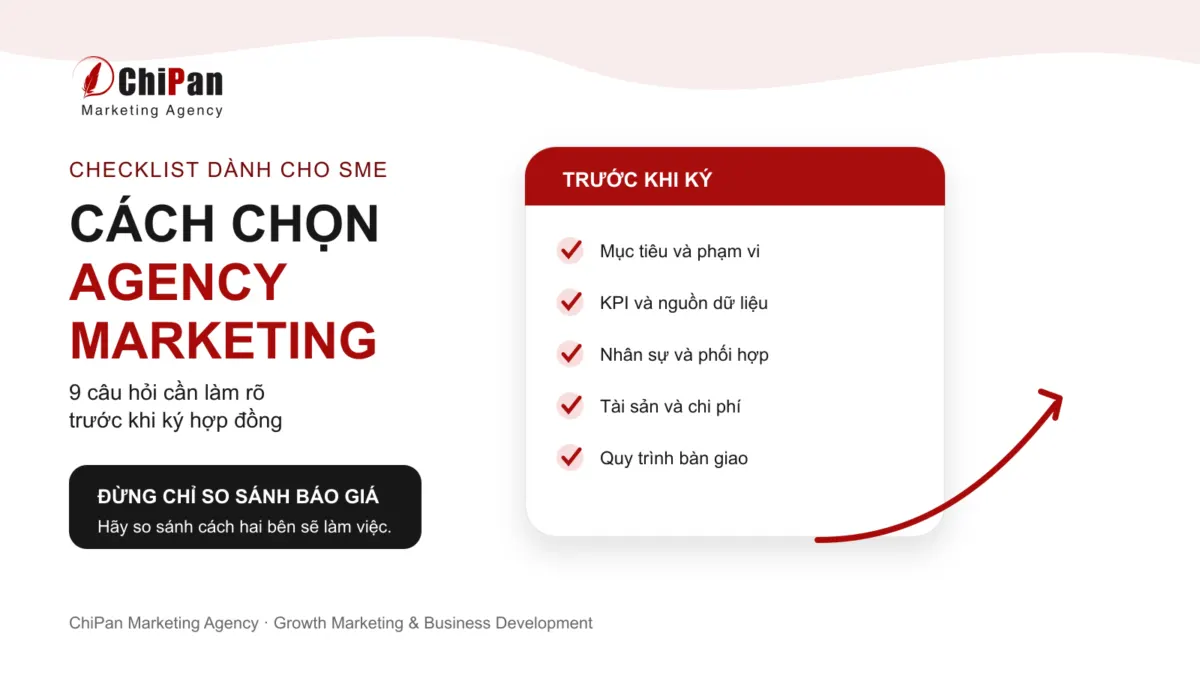
Checklist 9 questions helps SMEs compare agency marketing by scope, KPI, data, coordination and handover terms instead of just looking at quotes.
Quick Reply
The way to choose the right marketing agency is to start from the business problem, then check the scope of work, how to measure, the person directly in charge, ownership of the data and the terms of handover. SMEs should ask for a written answer to the 9 questions below before comparing the service fee or signing a contract.
A beautiful proposal can make a good impression, but it's not enough to predict how the two sides will work for months. For small and medium enterprises, the right choice is usually not the agency with the longest service list, but the unit that understands the right problem, proposes a moderate scope and is transparent about responsibility.
Before looking for an agency, what does SME need to clarify?
Enterprises should agree three inputs before the first meeting:
- Priority goals in the coming period: increase awareness, create leads, schedule, support sales or rebuild the marketing system.
- Actual resources: budget, data, coordinated personnel, lead processing capacity and content browsing speed.
- The bottleneck is seeing: lack of strategy, lack of executors, inefficient advertising, discrete content or not measured customer journey.
If the input is vague, agencies can understand the same brief in very different directions. At that time, it is easy for businesses to compare proposals that are not in the same range and choose according to the price instead of the appropriate level.
9 questions to clarify before signing the contract
1. How does the agency understand the business goals of the enterprise?
Ask the agency to re-interpret the problem in their language. The answer should show the relationship between marketing and product, customer, sales process and operating capacity, not only repeating the requirements of “running ads” or “doing content”.
A suitable agency also needs to clearly state what cannot be concluded without data. Asking deep questions is often worth more than a quick promise.
2. What is the scope of work and what does not include?
The service package name may be the same but the job is very different. SME needs a specific list of strategy, content, design, editing, advertising, website, report, recurring meeting and number of rounds to edit. At the same time, the contract should clearly state which parts of the business do it themselves.
The clearer the range, the less dependent on the progress and quality assessment.
3. Which output is delivered in stages?
Don't just ask "how many articles per month". Ask the output for which decision: content planner, message set, landing page, campaign structure, report learning, and next priority list.
With a long project, it is advisable to divide it into testable milestones instead of waiting until the end of the period to evaluate the whole.
4. Where is the KPI defined and retrieved from?
The two sides need to differentiate the performance metrics such as the number of contents produced, the marketing index such as the reach or lead, and the business indicator such as the appointment, order or revenue. Not all indexes are completely controlled by the agency.
Please agree on the data source, the time to close the numbers, how to handle the lack of data and the responsibility of the Sales team when receiving Lead. KPI only makes sense when the measurement is clearly stated.
5. Who is directly in charge of the project?
The proposal presenter may not be an operator on a daily basis. SME should know the management focal point, the person in charge of each expertise, expected response time and replacement mechanism when personnel are absent.
If the project needs to coordinate multiple channels, ask who is responsible for connecting the tasks to avoid each group optimizing an individual part.
6. What do businesses need to provide and how long to approve?
Outsourcing marketing still needs product data, sales policies, images, access and feedback from the business. The contract should clearly specify the required document, the reviewer, the response deadline and how to handle it when the input is delayed.
This is an important question because the slow results sometimes come from the coordination process, not just from the production capacity.
7. Who owns the original account, data and files?
Businesses should know who is in the name or holds administrative rights to websites, social networking sites, advertising accounts, measurement tools and data warehouses. Access should be enough for the job but should not depend on a single personal account.
The design file, footage, source code, customer file and campaign history are handed over or not included in the proposal or contract.
8. How is the service fee, advertising budget and incurred expenses separated?
A comparable quote needs to separate personnel/service fees, budgets paid for the platform, production costs and external purchases. SMEs should also ask about arising conditions, payment schedules, taxes and how to approve additional budgets.
Lower prices are not necessarily saving if the scope lacks important tasks or businesses have to compensate a lot of internal resources.
9. If the cooperation is stopped, how does the handover process take place?
Please clarify the notice period, the portfolio of assets handed over, the access rights to be recovered, the stored data and support for forwarding. A transparent closing process helps businesses reduce the risk of disruption, even when the two sides are cooperating well.
Checklist Compare Marketing Agency for SME
| Test content | Evidence should be required | Signs to ask for more |
|---|---|---|
| Understand the problem | Summary of targets, customers, bottlenecks | Only talk about available channels or packages |
| Range | Job List/Do not do | General description, difficult to accept |
| Output | Delivery milestones and approval criteria | Only guarantee quantity |
| KPI | Definition, data source, measurement cycle | Use revenue as a sure result |
| Personnel | Direct roles and leads | It is not clear who operates |
| Combination | input, browser, response deadline | All responsibility is on one side |
| Asset | Admin rights, original files, data | The agency holds all access |
| Fee | Fees for services, media, production, incurred | Quote without conditions |
| Finish | List and delivery time | No forwarding terms |
SMEs can dot each item at three levels: clear and proof; discussed but not recorded; not clear. The "unknown" points should be resolved before signing, instead of expecting the two sides to understand the same when deploying.
Signs that both sides may not be suitable
Not all differences are "red flags". An agency can be good but not suitable for the current stage of the business. SMEs should be reconsidered when the range is larger than the ability to coordinate, the timeline is incompatible, the input data is not ready or the measured result is not consistent.
On the contrary, the agency also needs to be frank when the budget, time or expectations are not suitable. This transparency helps both parties avoid a difficult contract to operate in the first place.
How does Chipan approach the selection step?
Chipan begins with a review of the status, goals, resources and bottlenecks before proposing scope. Depending on the problem, the business may need a specialized item, strategic consulting or outsourced marketing department model; It is not necessary to deploy all channels at the same time.
If you are considering how to choose an agency marketing, you can set a schedule to review your needs with Chipan to clarify the scope of priority, coordination and evaluation criteria before making a decision.
Frequently Asked Questions
How many agencies should SME compare before choosing?
No fixed numbers. It is important that the parties receive the same brief and are compared on the same criteria for scope, KPI, HR, data and cost.
Should you choose the lowest price agency?
Prices should only be compared after the range has been standardized. Lower fees may come with fewer jobs, fewer rounds, or businesses have to take on more parts themselves.
Should the agency commit revenue or leads?
Enterprises should ask the agency to explain the assumptions and what they control. Revenue, lead number and closing rate depend on product, budget, market and sales process.
How long should the cooperation test take?
The appropriate time depends on the range and cycle of purchase. The two sides should agree on the milestones of sufficient assessment to have data, but still have early check points on the process, output quality and coordination.
Do businesses need to keep admin rights to ad accounts?
Businesses should clarify ownership and access right from the start. The way of granting rights needs to serve the job but limited depends on the individual account or a single party.
Reference source
- Chipan's terms of cooperation and handover principles, compare 10/30/2026.
- official website chipan, page about chipan and description of the service, reconciliation on October 30, 2026.
- Official Google Ads documentation of a manager account and a client account link, compare 10/30/2026.
- Vietnam search results for the query group “How to choose an agency marketing”, check on October 30, 2026 to compare Search Intent and frequently asked questions.

ChiPan Marketing AgencyFrom creative work, content and advertising to restructuring marketing, sales channels and the operating model.