
Key takeaways
Clinic marketing is not just about running ads. The article presents a strategic framework from recognizing, building trust, searching for services to booking and post-examination care, with indicators to monitor to avoid optimizing the wrong bottleneck.
Quick Reply
Clinic marketing should be designed as a unified journey: helping people in need to know the clinic, find reliable information, understand the right service, make a convenient appointment and receive a consistent reception. To measure efficiency, the clinic needs to monitor from the source of access to the confirmation schedule, the rate of visiting and re-examination, instead of just looking at the views or the number of messages.
Clinic marketing doesn't start with channel selection
When the appointment schedule is not up to expectations, the familiar response is to increase your ad budget, post multiple videos or open one more channel. But advertising only partially solves the journey. Interested people can still stop because the website lacks information, does not believe in expertise, does not know if the clinic has received the right needs or has not received timely response.
Before choosing a channel, the clinic should clarify three questions:
- Which specialty or service group should be prioritized?
- What do people need to know and need to believe before booking?
- After the call or message, who confirms the calendar and updates the results?
These three questions help avoid the situation that marketing creates many contacts, but the receptionist cannot categorize the needs, or the content that attracts a group of people that the establishment is not suitable for.
Marketing must be tied to the scope of expertise and approval process. Advertising law and platform policy set specific conditions for Healthcare content, so messages, images and landing pages should be checked before running.
5 stage frame from recognition to booking
The clinic does not necessarily deploy every channel at the same time. More importantly, each stage has a mission, a destination and an indicator that is close enough to the business goal.
| Stage | Patient's question | Items to be prepared | Indicators should be tracked |
|---|---|---|---|
| 1. Identify the right needs | “Does my problem need to go to the doctor?” | educational content, doctor videos, local content | Right group views, saves, access to service pages |
| 2. Build trust | “Is this clinic suitable?” | Doctor profile, base information, process, real photos | Profile views, reading time, contact the right needs |
| 3. Search and Compare | “Where do you get this service?” | Website, Service Page, Google Business Profile | Calls, directions, visits to the service page |
| 4. Set and confirm calendar | “What do I need to do to receive?” | Call button, form, zalo/messenger, classification script | Confirmation schedule, response time, booking rate |
| 5. Come check and come back | “What do I need to prepare?” | Instructions, reminders, post-examination care | Rate of arrival, no-show, re-examination, reason for cancellation |
1. Create the correct recognition instead of just generating coverage
The content at the beginning of the journey should help viewers understand when to find professional advice, which needs the clinic receives and what to prepare; No individual diagnosis or treatment commitment. Short videos are suitable for common questions, the website explains the topic deeply, and Google Maps supports location needs.
2. Turn expertise into easy-to-check evidence
Patients often want to verify the team, service scope, process, location and time. The clinic should use the real property within the allowed disclosure range. Clear service pages, doctor records and specific FAQs are more useful than generic sentences like “top prestige”.
3. Connect the search to the correct landing page
People who seek specialists, services or “recent clinics” have a high level of initiative. Website and Google Business Profile need to unify the name, address, working hours and contact. Each priority service should have its own page with a process, FAQs, and a scheduling step, instead of leading every ad to the homepage.
4. Consider the reception process as part of marketing
The campaign can create multiple calls but few calendars if the response is slow. Marketing, reception and expertise need to unify the following states: new contact, right needs, need to add information, schedule confirmation, have arrived, canceled and not booked. Each state has the person in charge and the next step to properly identify the bottleneck.
5. Measure to the appointment schedule, do not stop at the booking schedule
The set schedule is not the end result. It is necessary to monitor the incoming rate and reason for no-show such as forgetting the schedule, changing the time or the inappropriate demand. Confirmation, guidance and post-examination care must follow professional procedures, protect personal data and do not use patient images without appropriate grounds.
Assigning channels to avoid doing a lot but discretely
A compact system can start from four groups:
- Website and service page: Platform information and destination for advertising.
- Google Search and Google Business Profile: Responsible for service and location.
- Social network: Build awareness and help viewers get acquainted with the team.
- Phone, Form, Zalo or Messenger: Receiving and confirming the calendar.
Not every clinic needs every social network. Small establishments can prioritize websites, Google Business Profile and a maintainable content channel. If the internals keep the expertise and approval but lack the coordination, the hybrid model can be used or Outsourcing Marketing Department with clear range.
Minimum KPI for 90 day cycle
The clinic can start with:
- Costs and contacts by source.
- Rate of contact right.
- contact rate to confirmation calendar.
- Confirmation rate.
- median response time.
- Reason for cancellation, no-show or unset.
- Number of re-examination schedules if within the scope of monitoring.
Views and interactions are support signals; The calendar creation report needs to connect the channel with the confirmation calendar and visits. In the project Vinaligan Dental Clinic, Chipan deploys multi-channel marketing, specialized content and consulting training. This is a case of dentistry, which does not represent every clinic, but shows that it is necessary to look at both the attraction channel and the reception process.
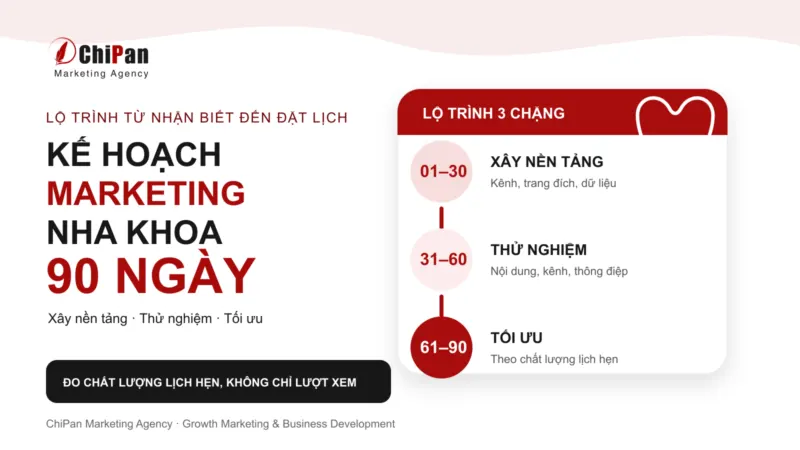
In the first 30 days, the clinic should choose one to two priority services, check the website and Google Business Profile, standardize the lead status, and then try a content theme and a small search campaign. After 30 days, the team needs to answer: where do people in need come from, where do they stop and what data is missing.
View more Chipan's overall marketing service and category Marketing clinic.
Frequently Asked Questions
Which channel should the small clinic start marketing from?
It is recommended to start from the website or service page, Google Business Profile and a contact channel with the person responsible for feedback. Then choose a social network that the team can maintain evenly.
Is running ads general clinic marketing?
No. Advertising is an access channel. Overall marketing also includes positioning, content, search assets, landing pages, reception processes, data and after-contact care.
The most important KPI is the number of messages or appointments?
With a calendar creation campaign, it is recommended to monitor the least confirmation calendar and visit rate. The number of messages only indicates that someone has started to contact, not reflecting the quality of the demand.
Who needs to be approved by the clinic?
There should be a professional in charge of medical information and managers to check advertising conditions when needed. The approval process must be agreed before the production schedule.
When should you hire an agency or an outsourcing marketing department?
When the goal needs many coordinated roles but the team lacks a leader, lacks advertising capacity or does not connect data with the reception process. Outsourcing should clearly state the job, access rights, KPI and handover data.
Get advice
If the clinic's content, ads and appointments are not in the same system, send Chipan three information: Priority Services, running channels, and how the team records appointments. Chipan will make a preliminary exchange to determine the point to be audited and the appropriate range.
Reference source

ChiPan Marketing AgencyFrom creative work, content and advertising to restructuring marketing, sales channels and the operating model.